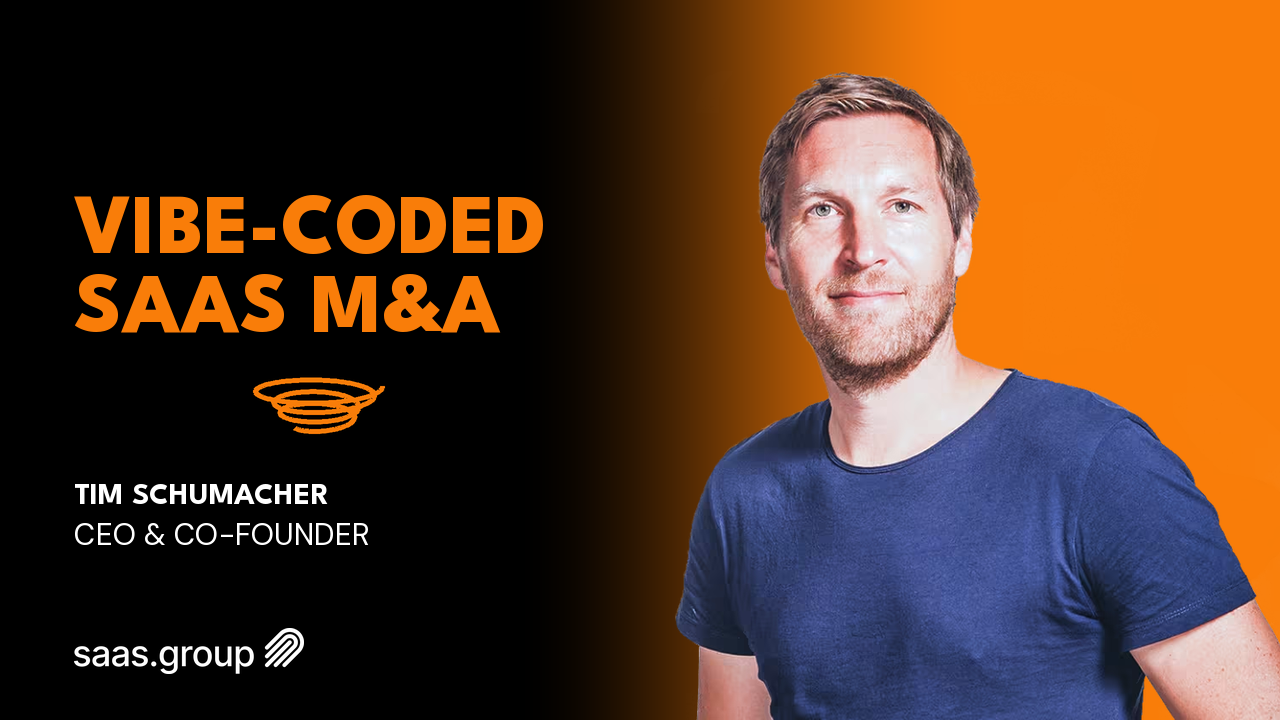
As a co-founder of saas.group, where we acquire and operate 24 SaaS businesses such as Tower, DeployHQ, ScraperAPI, I see firsthand how AI is changing software building and acquisition. Recent market data highlights how rapidly this is changing. A BairesDev study recently revealed that 42% of software engineers now generate half or more of their code using AI tools, up from 12% a year prior. Similarly, 25% of startups in Y Combinator’s Winter 2025 cohort possessed codebases that were 95% AI-generated. These were not simply non-technical founders outsourcing development to AI. The founders were highly technical people who, only a year earlier, would have written much of that code themselves.
The question now is not how AI can help founders build software fast, but what happens when someone wants to buy one of these businesses?
As those businesses mature, the implications will extend well beyond how software is developed. The next generation of SaaS acquisitions will increasingly involve businesses where AI played a fundamental role in creating the product, and buyers will need to decide whether that changes what they are buying and how they assess it.
At saas.group, AI-assisted codebases are increasingly common among the companies coming to market. Our view is that AI-generated code is not inherently a problem. What matters much more is whether the company understands what it has built.
That distinction is important. Vibe coding makes it possible to ship a working product without necessarily understanding every component underneath it. That can be a perfectly rational trade-off when a founder is trying to establish whether customers actually want something. It becomes more complicated when another company is considering spending a serious amount to own and operate that product for the next decade.
We are already seeing signs that AI is changing the way buyers think. Bain’s 2026 Global M&A Report found that one in five strategic dealmakers had walked away from a deal because of the anticipated impact of AI on the target’s business. Almost half of strategic tech deals over $500M now have some form of AI angle. AI is no longer a peripheral technology question during M&A. It is becoming part of the assessment of whether an asset will retain its value, and for SaaS companies built extensively using AI, that scrutiny is likely to reach all the way into the codebase.
Until recently, technical diligence generally started from an assumption that the engineering team understood the software it had built. Vibe coding challenges that assumption, and a buyer now needs to work through different questions with founders. How much of the code was generated by AI? Can the team explain the architecture? Does the company clearly own its intellectual property? And perhaps most importantly, can somebody else maintain and debug the product after the founder who built it has left?
None of this means vibe-coded companies should automatically attract lower valuations. In fact, the opposite could be true. One of the most exciting consequences of AI-assisted development is the possibility of a new generation of exceptionally capital-efficient SaaS businesses. A founder who can reach meaningful recurring revenue with two people rather than 20 has potentially built an extremely attractive company. Development costs can be lower, iteration can be faster and the economics of running the business can look very different.
The dividing line will be between businesses that have used AI to accelerate good development and those that have allowed the speed of development to outpace their understanding of what they have built. That is why one of the answers that slows a deal down most is: “We don’t really know”, which is an answer founders can easily avoid with a little preparation. Acquirers are used to risk. Every software company has technical debt and every acquisition involves assumptions about what will happen next, but what is much harder to price is uncertainty.
For founders, this means thinking about acquisition readiness much earlier. The speed of vibe coding encourages a mindset in which technical debt can always be dealt with later. That is understandable when the priority is reaching product-market fit, but founders need to close the gap between what their product can do and what their organisation can explain.
That means documenting architecture, understanding dependencies and licences, reviewing security particularly closely around payments and personal data, and keeping a sensible record of where AI-generated code has been used and reviewed. It also means ensuring that knowledge of how the product operates belongs to the company rather than sitting with one founder and the AI tools they used to create it.
None of this undermines the vibe-coding revolution or means founders should be more cautious about using AI. It is merely evidence that it is growing up. The ability to build and test software at a fraction of the traditional cost is one of the biggest opportunities SaaS founders have had in years; but speed at the beginning of a company’s life creates new responsibilities as it grows.
Across the saas.group portfolio, sustained growth hinges on the fusion of fast execution and ownership of operations. While AI tools help in product development, the sustained value of assets will depend on rigorous engineering practices and clear documentation. Founders who keep complete visibility into their software architecture will be in a much stronger position when they sell.
Tim Schumacher is CEO & Co-Founder at saas.group.