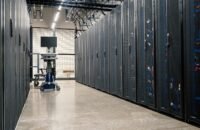
Etched announced on August 18 that it raised $700 million in a round led by Jane Street, valuing the company at $21 billion, roughly double the $10.3 billion valuation it held after a Series C just a month earlier. Kleiner Perkins, Sequoia, Andreessen Horowitz, Tiger Global, Bain Capital Ventures, and Blackstone also participated. The round comes alongside Etched’s first customer delivery: a production inference cluster built on its custom chips, now running live workloads inside Jane Street’s trading infrastructure.
What was announced
Etched builds inference chips purpose-built for transformer models, using what it calls Low Voltage Inference and Cluster Scale Memory designs rather than general-purpose GPU architecture. CEO Gavin Uberti framed the milestone directly: “Jane Street putting this cluster into production is proof of what we’ve built. Now, we’re sprinting on scaling production.” Kleiner Perkins managing partner Mamoon Hamid described the thesis behind the round: “Inference is becoming one of the most important infrastructure markets in AI, and the winners will be measured by tokens per dollar and per watt.”
Why it matters to enterprise AI buyers
Etched’s valuation jump is a market signal, not just a funding headline: investors are pricing in a real chance that purpose-built inference silicon displaces general-purpose GPUs for at least some production AI workloads, the same wager behind Anthropic’s own custom-chip program disclosed earlier this month. For an enterprise buying inference capacity at scale, a validated production deployment at a demanding customer like Jane Street is a more useful signal than a benchmark claim, and it is worth asking any infrastructure vendor, custom-silicon or GPU-based, for a similar production reference before committing to a multi-year compute contract measured on cost per token rather than raw throughput.
Source: GlobeNewswire